
English
English
Views: 0 Author: Site Editor Publish Time: 2026-06-03 Origin: Site


In hardware development for vision-enabled products, the terms "image sensor" and "camera module" are often conflated. This confusion leads to misaligned procurement and costly engineering bottlenecks. Choosing between integrating a bare sensor and using a complete assembly can significantly alter the project timeline, R&D budget, and the level of in-house technical expertise required. Building camera hardware from scratch requires substantial resources, while sourcing a pre-integrated solution can eliminate weeks of complex parameter tuning.
This guide clarifies the technical boundaries between these two core components, explains the practical challenges involved in system integration, and provides a clear framework for product designers, procurement teams, and engineering managers to make informed decisions.
Scope: An image sensor is the silicon chip that captures incoming light, while a camera module is an integrated assembly that typically combines a sensor, lens, housing, and supporting circuitry.
Engineering Overhead: Integrating an image sensor independently requires focus calibration, driver development, ISP parameter tuning, and controlled manufacturing conditions. Camera modules transfer much of this work to the module manufacturer.
Cost and Production Volume: Image sensors may offer a lower component cost, but they require higher upfront engineering and manufacturing investment. Camera modules usually provide a faster and lower-risk path to production.
An image sensor is the fundamental semiconductor component inside a vision system. Most modern electronic products use Complementary Metal-Oxide-Semiconductor (CMOS) sensors, while some specialized or legacy systems still use Charge-Coupled Devices (CCD). Its primary function is to convert incoming photons into measurable electrical signals, effectively acting as the digital retina of the device.
An image sensor only outputs raw data, usually in a Bayer-pattern array. This raw output does not yet contain complete color-image information. The sensor chip itself also has no focusing capability. You cannot simply point a sensor at an object and obtain a clear image because the incoming light will not be properly focused onto the pixel array. Hardware developers must design a complete lens and supporting structural system above the sensor to achieve focused imaging.
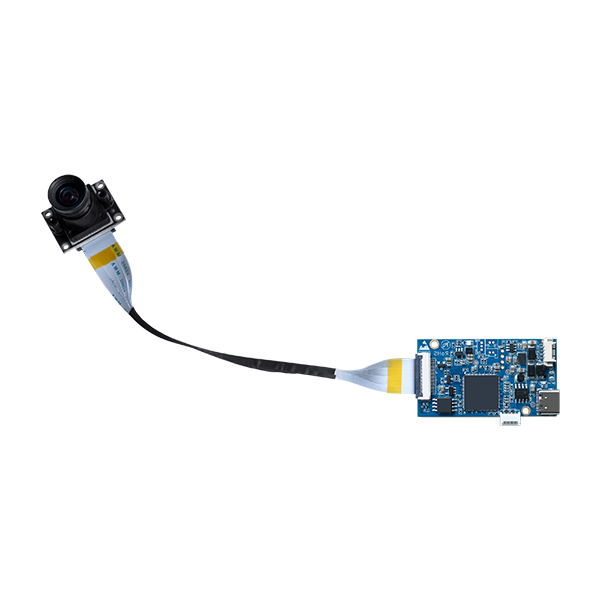
A camera module is a complete optoelectronic assembly that has already been assembled and tested. It connects the image-sensor chip to a usable video output. During production, the manufacturer completes the component assembly and can provide standardized digital video signals for external systems. This reduces the need for customers to manually adjust image color and related imaging parameters.
A complete camera module generally contains the following core components:
Image Sensor: The light-sensitive silicon chip responsible for receiving incoming light.
Lens Assembly: A precisely combined group of plastic or glass lens elements that focuses light onto the sensor's pixel array.
Autofocus Motor (VCM): An electromechanical component used to adjust focus automatically.
Printed Circuit Board (PCB/FPC): A rigid or flexible circuit board that transmits power, control signals, and image data.
Digital Signal Processor or Image Signal Processor (DSP/ISP): A processing component that converts raw electrical signals into standard video or image outputs such as LVDS, MIPI, IP video, MJPEG, and YUV.
Product selection should not be based solely on individual component pricing. Hardware teams also need to evaluate the engineering work, manufacturing risks, and integration resources associated with each option.
When using an image sensor independently, the equipment manufacturer must complete an Active Alignment (AA) process. During lens installation, the sensor is powered on and the lens position is adjusted in real time to ensure that the entire image area remains in focus. The manufacturer must also perform Lens Shading Correction because the optical characteristics of a lens can cause the corners of an image to appear darker than the center.
With a camera module, the manufacturer completes focus calibration, edge-image optimization, and chromatic-aberration correction during production. The optical parameters of the delivered module are tested against the agreed specifications before shipment.
Directly integrating an image sensor requires substantial development capability. Engineers need to write sensor drivers and tune ISP parameters for different lighting conditions. Auto-exposure, white balance, noise reduction, and other algorithms may require hundreds of hours of laboratory testing. Incorrect tuning can result in color casts, excessive noise, unstable exposure, or other image-quality problems.
A camera module is a usable subassembly whose factory-level tuning has already been completed. Mainstream LVDS, MIPI, IP, and UVC camera modules can be adjusted for color, exposure, and focus before shipment. Customer engineers can therefore concentrate on developing end-product functions without needing to master camera-imaging principles or specialized image-processing techniques.
Assembling an image sensor and lens internally creates substantial production risk. Even a microscopic dust particle can damage the effective imaging area or produce permanent image defects. Companies performing lens assembly themselves may need to invest in controlled cleanroom facilities, specialized equipment, and production processes. They must also absorb the cost of defective units and material loss.
Selecting an integrated camera module transfers much of this risk to the module manufacturer. The manufacturer is responsible for clean production, assembly yield, and defective-unit losses. The customer only needs to inspect and purchase tested, qualified modules.
The appropriate solution depends on the product-development model, production volume, and technical capabilities of the organization. The two most common application scenarios are outlined below.
This approach is suitable for teams with strong low-level development capabilities and products requiring extensive customization.
Suitable Conditions: The product is planned for extremely high-volume production, allowing small reductions in Bill of Materials (BOM) cost to produce meaningful savings. This option may also be appropriate when the product has strict size or structural requirements and needs a customized sensor-to-board installation design, such as an ultra-thin mobile device.
Required Capabilities: The team should include experienced imaging or lens engineers, an ISP-tuning specialist, and a manufacturing partner with a compliant cleanroom and precision assembly equipment.
If the company does not have these capabilities, independently integrating an image sensor can easily cause production delays and repeated development work.
Most B2B and industrial hardware projects benefit from using pre-integrated camera modules. This approach reduces unpredictable engineering work and simplifies product validation.
Suitable Conditions: The project prioritizes rapid time to market, predictable integration schedules, and verified imaging performance.
Required Capabilities: The engineering team can focus its resources on the final product, including artificial-intelligence algorithms, mechanical design, control systems, and user-interface development.
By assigning camera assembly and image tuning to a specialized module manufacturer, the customer can accelerate prototype iterations and turn hardware verification into a controlled qualification process rather than a long-term imaging research project.
Different industries have different requirements for resolution, shutter type, low-light performance, environmental protection, data interfaces, and regulatory compliance. A standard consumer camera module may not be suitable for industrial or medical environments.
Autonomous navigation equipment places strict requirements on imaging quality. Image distortion, motion blur, or unstable lens positioning can cause system failures. Vibration during equipment operation can also affect focus accuracy.
Typical Applications: Drones, warehouse robots, and deep-sea underwater robots.
Module Requirements: A global-shutter module should be used so that all pixels are exposed simultaneously, reducing motion artifacts. The module should also have a vibration-resistant structure to prevent lens displacement and support low-latency data transmission for real-time system response.
Security monitoring and industrial production environments often contain complicated lighting conditions. Equipment must operate reliably under low light, bright light, and rapidly changing illumination while maintaining consistent imaging accuracy.
Typical Applications: Security monitoring and automated industrial inspection systems.
Module Requirements: A 4MP/8MP Starlight Full-Color USB Camera Module can provide strong low-light imaging performance. High Dynamic Range (HDR) helps preserve details in both bright and dark areas. A reinforced and sealed structure can also protect the module against dust and moisture.
Medical and video-communication systems emphasize image clarity, operational stability, and industry compliance. Image defects can directly affect diagnostic work, remote collaboration, and user experience.
Typical Applications: Medical devices, medical inspection, video conferencing, and distance education.
Module Requirements: Inspection equipment may require precise macro-focus capability. Medical equipment must meet Electromagnetic Interference (EMI) requirements to avoid affecting nearby devices. Video-conferencing and educational equipment can use a standard 1080P Full HD Camera Module to provide stable video transmission and manageable bandwidth requirements.
Highly integrated, high-resolution, and high-framerate camera modules can generate substantial heat. Excessive temperature increases dark-current noise, which may appear as colored noise or image artifacts. Hardware engineers should design an appropriate heat-dissipation structure and review the supplier's thermal test reports. Continuous-operation data should also be verified to ensure that the module housing can transfer heat effectively to the product chassis.
The module's output interface must be fully compatible with the host processor. Selecting an unsuitable interface may require the entire circuit board to be redesigned.
A MIPI CSI-2 interface provides high bandwidth and can transmit raw image data directly to an embedded host processor, but it generally requires more driver and software-integration work. A USB interface uses standard UVC drivers and reduces the amount of software development required, making it suitable for external or peripheral devices.
The interface should be selected according to the host architecture, required bandwidth, system latency, and available software-development resources.
Before placing a formal mass-production order, the customer's team should verify the supplier's qualifications and product performance. Recommended actions include:
Request MTBF Data: Review Mean Time Between Failures data to evaluate long-term product reliability.
Verify Certifications: Confirm basic certifications such as CE, FCC, and RoHS. Medical-device projects should also verify whether the supplier holds an applicable ISO 13485 certification.
Request Evaluation Samples: Test the actual product dimensions, heat generation, imaging performance, interface compatibility, and operational stability before signing a customization or mass-production agreement.
The image sensor is the core light-sensitive component of a vision system, while the integrated camera module is a complete solution that can be connected to and used within a product. For most commercial hardware-development projects, selecting a pre-tuned camera module can substantially reduce project risk, eliminate the need to establish a dedicated cleanroom assembly process, shorten the product-development cycle, and reduce hidden costs associated with driver development, ISP tuning, and production defects.
Companies should first evaluate their internal imaging-development capabilities, project schedule, manufacturing resources, and software expertise before deciding which approach to use. Teams without experienced ISP-tuning personnel should generally avoid direct image-sensor integration. Instead, they should work with a specialized camera-module manufacturer, review the relevant technical specifications, and request samples for hardware testing as early as possible.
A: This is generally not recommended. Camera modules are precisely focused and aligned during manufacturing, and the relative position between the lens and pixel array is strictly calibrated. Opening the sealed housing can destroy the original positioning accuracy and allow dust to enter the module, directly reducing image quality.
A: No. USB camera modules generally integrate an ISP and output standardized video signals for convenient use. Most MIPI camera modules output raw image data and rely on the ISP or image-processing system inside the host processor.
A: A camera module usually has a higher per-unit material cost. However, the total cost of independently integrating an image sensor—including R&D investment, cleanroom operation, precision assembly, ISP tuning, and production-yield losses—can be substantially higher than the price difference between the two components.


