
English
English
Views: 0 Author: Site Editor Publish Time: 2026-02-04 Origin: Site


In the professional imaging field, the saying "Details determine success or failure" is never an empty phrase. From capturing tiny clues in security surveillance, identifying subtle defects in industrial inspection, to delivering clear images for remote education, the presentation of every detail relies on the critical parameter support of the core component—the image sensor.
Pixel Size, regarded as the invisible core competitiveness of a sensor, directly determines the device’s light intake, signal-to-noise ratio and dynamic range, ultimately defining the upper limit of imaging quality.
Today, our company, an officially authorized distributor of Sony (China), focuses on two star camera modules of Sony—the FCB-ER9500 and FCB-EV9520L. Starting from pixel size, we conduct an in-depth analysis of their imaging differences and applicable scenarios, helping you accurately match your needs and choose the most suitable one!
I. How Important Exactly Is Pixel Size?
Before we dive into specific products, let’s quickly break down this key technical concept: Pixel Size refers to the physical dimension of a single pixel on the image sensor, usually measured in micrometers (μm).
Simply put, a larger pixel size means a bigger light-sensitive area per pixel. This allows the sensor to capture more photons, resulting in a higher signal-to-noise ratio (SNR) in low-light conditions, with fewer image noises and cleaner details. At the same time, larger pixels also enhance dynamic range, ensuring that bright areas retain details without overexposure and dark areas remain visible in high-contrast scenes.
Conversely, smaller pixels enable higher pixel density on sensors of the same size, making them ideal for scenarios that demand high resolution. However, this requires advanced algorithm optimization to control noise. Both of these Sony modules are equipped with cutting-edge STARVIS™ 2 technology sensors, and their core differences lie in the combination of pixel size and sensor specifications.
II. Core Comparison: FCB-ER9500 vs FCB-EV9520L - Pixel Size & Imaging Advantages
To understand the pixel size differences between these two models, let’s first take a look at a set of core parameter comparisons (data sourced from Sony’s official specifications and verified by actual tests).
Parameter Dimensions | Sony FCB-ER9500 | Sony FCB-EV9520L |
Sensor Size | 1/1.8-inch STARVIS™ 2 CMOS | 1/2.8-inch STARVIS™ 2 CMOS |
Effective Pixels | Approx. 8.4 Megapixels (4K Resolution: 3840×2160) | 1920×1080)Approximately 2.13 mega (Full HD Resolution: 1920×1080) |
Pixel Size | Approx. 2.0μm (Officially Specified by Sony) | 2.9μm (Officially Provided by Sony) |
Core Imaging Advantages | 4K Ultra HD Details + Excellent Low-Light Performance | Large Pixel Size & High Signal-to-Noise Ratio + 130dB Ultra-Wide Dynamic Range |
It’s easy to see at a glance from the table that the two products differ significantly in pixel size, which directly shapes their respective strengths in imaging performance:
1. Sony FCB-EV9520L: 2.9μm Large Pixel Size--The Ultimate Choice for Low-Light & High-Contrast Scenarios.
The 2.9μm large pixel size equipped in the FCB-EV9520L stands out as one of its core competitive advantages. Combined with the STARVIS™ 2 back-illuminated pixel technology, this camera module delivers dramatically enhanced light sensitivity. It is capable of capturing clear color images even in extremely low-light conditions of 0.009lx (with ICR off); and in total darkness, it can achieve high-quality night vision imaging by leveraging near-infrared illumination.
The larger pixel size also ensures outstanding dynamic range performance--its 130dB ultra-wide dynamic range far exceeds the human eye’s 120dB perception limit. Paired with the dual-engine DOL HDR and Clear HDR technologies, the module effectively eliminates overexposure caused by strong light reflections while preserving rich shadow details. Whether it’s for outdoor security surveillance under direct glare, or industrial workshop inspection in complex lighting environments, it consistently delivers exceptional results with no overexposure in bright areas and clear visibility in dark zones.
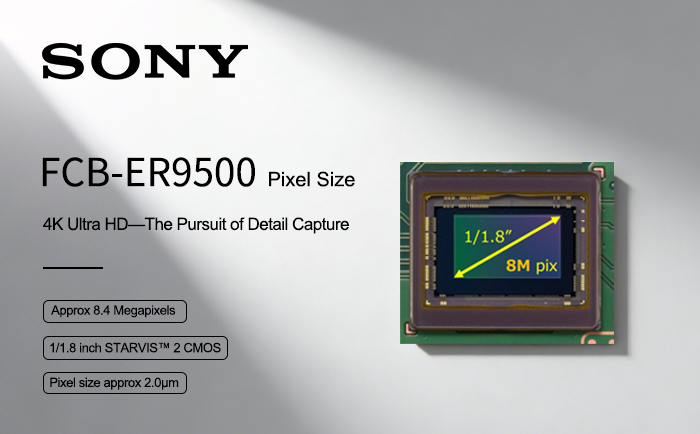
2. Sony FCB-ER9500: 2.0μm Pixel Size + 4K Ultra HD – The Pinnacle of Detail Capture
Some may wonder: since the FCB-ER9500 has a smaller pixel size than the FCB-EV9520L, does that mean its imaging performance is inferior? The answer is no! The 2.0μm pixel size of the FCB-ER9500 is a tailor-made optimization solution for 4K Ultra HD resolution.
Despite the slightly smaller individual pixel size, this camera module is equipped with a larger 1/1.8-inch sensor. Combined with its 8.4-megapixel high resolution, it achieves an ideal balance between sharpness and low-light performance. Boasting 4 times the pixel density of Full HD, its 4K resolution can capture the finest details—such as tiny fluctuations on liquid surfaces, subtle defects on metal parts, and minuscule text on documents—details that are nearly impossible to discern with Full HD devices.
Moreover, the 2.0μm pixel size paired with STARVIS™ 2 technology enables a minimum illumination of 0.00016lx, ensuring exceptional noise control even in dim environments. Complemented by high frame rate output of 4K/60fps, it delivers ultra-smooth footage for dynamic scenes, perfectly catering to scenarios with dual demands for detail and fluency, including premium security surveillance, medical monitoring, and remote education.
III. Scenario-Based Selection Guide: Find Your Tailored Imaging Solution
Now that we’ve explored the differences brought by pixel size, we move on to the most critical step—selection. Based on the requirements of diverse application scenarios, we’ve compiled precise recommendations for you:
Scenarios Where Sony FCB-EV9520L is the Preferred Choice:Outdoor security surveillance (with frequent strong light reflections), industrial inspection (complex lighting conditions & high dynamic range requirements), lightweight device integration (weighing only 239g, ideal for space-constrained scenarios), and low-light night vision applications (e.g., community nighttime monitoring, underground parking lot inspection).
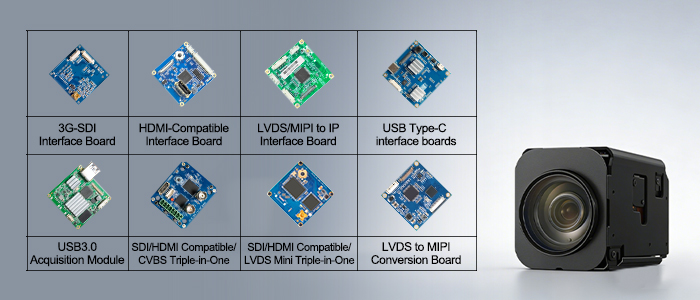
Our company, a dedicated provider of HD video secondary development solutions, has independently developed a full range of interface boards with diverse interfaces for the Sony FCB-EV9520L. The lineup includes 3G-SDI, LVDS/MIPI-to-Ethernet, SDI/HDMI Compatible/CVBS 3-in-1, HD-HDMI Compatible, LVDS-to-MIPI, USB3.0, and USB Type-C interface boards as well as video capture modules. Users can select the optimal interface board based on their specific scenario requirements to deploy customized solutions for video capture, conversion, and transmission.
Scenarios Where Sony FCB-ER9500 is the Preferred Choice:4K Ultra HD surveillance (e.g., high-end venues, critical security zones), precision industrial inspection (where capturing minute details is essential), medical surgical monitoring (requiring clear documentation of surgical field details), remote teaching/live streaming (needing delivery of crisp 4K visuals), and professional imaging scenarios with stringent resolution demands.
Similarly, the Sony FCB-ER9500 can be paired with encoding and control boards such as 4KP60 HDMI Compatible, 4KP60 AI Ethernet, 12G-SDI, 4K USB Type-C, and 4K HDMI Compatible to deliver turnkey video solutions for targeted application scenarios.
Conclusion: No “Best”, Only “Best Fit”
Back to the core question: Is a larger pixel size always better? A comparison between the Sony FCB-ER9500 and FCB-EV9520L shows that the answer is “not necessarily”—choosing a pixel size essentially boils down to balancing resolution requirements and ambient light conditions of the application scenario.
The 2.9μm large pixel size of the FCB-EV9520L is the optimal solution for low-light and high-contrast scenarios; meanwhile, the 2.0μm pixel size of the FCB-ER9500 stands as the ideal choice for scenarios demanding 4K Ultra HD details. Both models inherit the outstanding capabilities of Sony’s STARVIS™ 2 technology, delivering top-tier imaging performance in their respective fields of expertise.


