
English
English
Views: 0 Author: Site Editor Publish Time: 2026-08-27 Origin: Site


Global Shutter enables simultaneous exposure across all pixels to completely eliminate the “jello effect”, making it essential for industrial inspection, UAV inspection and AI‑powered intelligent recognition. This article systematically reviews the value and advantages of global‑shutter cameras, covering principle comparison, core benefits, application scenarios and selection guidelines.

A global‑shutter camera is an imaging device where all pixels on the sensor start and finish exposure at the exact same time. It can “freeze” high‑speed moving scenes within an extremely short time, physically eliminating motion distortion and the jello effect caused by rolling shutter.
It serves as a core technology to guarantee geometric accuracy and timing consistency in machine vision, industrial automation and high‑speed dynamic capture scenarios.
To appreciate the value of global shutter, one must first understand the limitations of conventional Rolling Shutter. The two technologies differ fundamentally in operating mechanism:
2.1 Rolling Shutter
It exposes pixels row‑by‑row like a descending set of blinds, with microsecond‑level time gaps between rows. When capturing fast‑moving objects, time misalignment causes image tilting, stretching or jello‑like distortion. Most Sony FCB auto‑focus camera modules adopt rolling‑shutter technology, delivering high light sensitivity in low‑light conditions and cost‑effective performance.
2.2 Global Shutter
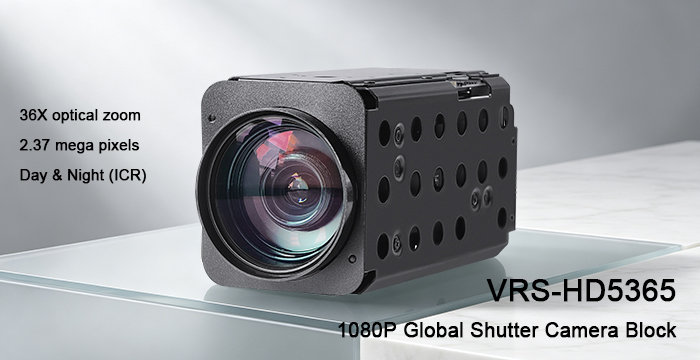
All pixels switch exposure simultaneously, similar to capturing an image with a flash. Data is read out row‑by‑row only after exposure completes. Every area of the image shares identical timing, with no motion distortion[1]. The VRS‑HD5365 integrated camera module features global‑shutter technology, delivering sharp imaging even under high‑speed motion conditions.
| Comparison Dimension | Global Shutter | Rolling Shutter |
|---|---|---|
| Exposure Mode | Simultaneous exposure for all pixels | Sequential exposure row‑by‑row / column‑by‑column |
| Motion Distortion | None; high geometric fidelity | Present; prone to jello effect |
| Synchronization Performance | Supports hardware trigger, microsecond‑level synchronization | Difficult synchronization with row‑to‑row delay |
| Quantum Efficiency | Slightly lower fill factor (improved by new technologies) | Higher; excellent low‑light performance |
| Cost | Higher (complex sensor manufacturing process) | Lower (mature industrial supply chain) |
| Typical Applications | Industrial inspection, robotics, UAVs, unmanned boats and other mobile unmanned devices | Surveillance, medical equipment, video conferencing |
3.1 Complete Elimination of Motion Artifacts
When capturing moving objects traveling faster than 0.5 m/s (e.g., conveyor‑belt parts, propellers, speeding vehicles), rolling‑shutter jello effect may introduce dimensional measurement errors. Global shutter renders undistorted true contours, ensuring accuracy for AOI inspection and dimensional metrology.

3.2 External Trigger Synchronization
Global‑shutter sensors can precisely align with external events such as laser pulses, encoder signals and strobe lights, enabling multi‑camera synchronous acquisition or high‑speed snapshot during motion — an indispensable capability for high‑end automated production lines.
3.3 Resistance to LED Flicker Interference
With synchronized exposure across all pixels, global shutter offers superior anti‑flicker performance against periodically flashing light sources such as industrial LED lighting. It prevents alternating bright‑dark stripes in images and improves AI recognition accuracy.
Technical Breakthrough: Sony’s new‑generation Stacked CMOS sensors separate the photosensitive layer from the logic layer. This greatly improves quantum efficiency and readout speed for rolling‑shutter devices, narrowing the exposure performance gap versus global‑shutter solutions.
Q: Do global‑shutter cameras produce more image noise than rolling‑shutter cameras?
A: Traditional front‑illuminated global‑shutter sensors may have slightly higher read‑out noise because circuitry occupies pixel area. However, modern back‑illuminated (BSI) and stacked global‑shutter sensors have significantly optimized signal‑to‑noise ratio. For most industrial use cases, the difference is negligible.
Q: Is a global‑shutter camera mandatory for UAV pod integration?
A: Not necessarily. Selection depends on your application requirements. Global‑shutter cameras are recommended for scenarios sensitive to motion distortion (e.g., high‑speed gimbal zoom). Otherwise, high‑performance rolling‑shutter cameras can be used. Most Sony FCB series (FCB‑ER9500, FCB‑EV9520L, etc.) adopt high‑performance CMOS sensors.
[1] Differences between Rolling Shutter and Global Shutter
https://blog.csdn.net/weixin_50562795/article/details/140233661


