
English
English
Views: 0 Author: Site Editor Publish Time: 2026-02-26 Origin: Site


In cutting-edge fields such as drone obstacle avoidance, robotics, and autonomous driving, sensors act as the "intelligent eyes" of devices, and their performance directly determines the reliability and safety of the entire system.
However, traditional sensors often struggle to balance accuracy and stability under extreme lighting conditions—intense glare interference from midday sunlight and weak signal challenges in complete darkness.
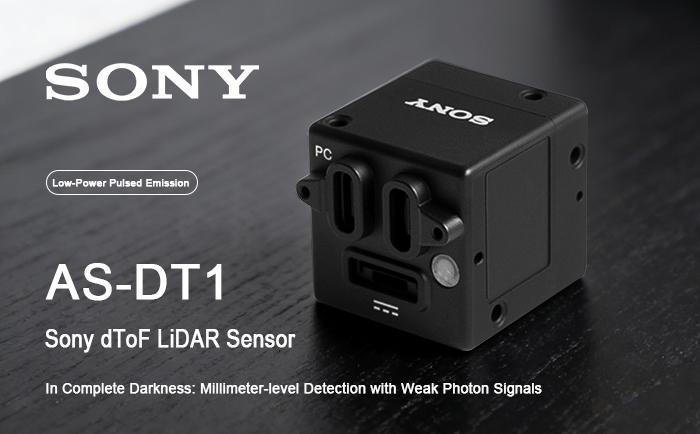
Sony’s newly launched dToF (Direct Time-of-Flight) LiDAR Sensor AS-DT1, with its revolutionary technological breakthroughs, demonstrates robust all-weather, all-scenario sensing capabilities in these two extreme environments, setting a new benchmark for obstacle avoidance in drones and robotics.
I. Under Midday Sunlight: High-Precision Ranging in 100,000 Lux Intense Light
In outdoor scenarios, the intensity of midday sunlight can reach up to 100,000 lux. Traditional iToF (Indirect Time-of-Flight) sensors are prone to signal aliasing caused by ambient light reflection, resulting in large ranging errors or even complete failure. In contrast, Sony’s dToF LiDAR Sensor AS-DT1 completely breaks through this bottleneck with two core technologies:
1. SPAD Single-Photon Level Sensitivity
Sony’s self-developed SPAD (Single-Photon Avalanche Diode) pixel structure can capture weak signals of individual photons. Combined with TCSPC (Time-Correlated Single-Photon Counting) technology, it constructs a photon arrival time histogram. Even under direct sunlight, the sensor can filter out invalid photons through the statistical histogram and only respond to the effective signals reflected by the target, ensuring ranging stability.

2. Anti-Multipath Interference
AlgorithmIn complex environments, light may reach the sensor after multiple reflections, leading to ranging errors. The Sony dToF LiDAR Sensor AS-DT1 accurately distinguishes between directly reflected light and multipath interference light via dynamically optimized signal processing algorithms. It achieves high precision with an error of less than ±5 cm at a 10-meter distance, and can maintain stable ranging up to 40 meters even in strong outdoor light conditions.
II. In Complete Darkness: Millimeter-level Detection with Weak Photon Signals
In fully dark environments, traditional sensors fail to operate due to insufficient reflected light. In contrast, Sony’s dToF LiDAR Sensor AS-DT1—leveraging its SPAD pixel architecture—emerges as one of the few technical solutions capable of achieving high-precision ranging in total darkness:
1. Weak Light Enhancement Solution
The Sony dToF LiDAR Sensor AS-DT1 adopts a back-illuminated SPAD pixel structure. Even when targeting objects with extremely low reflectivity (e.g., black surfaces), the sensor can capture sufficient reflected photons to perform distance calculations accurately.
2. Low-Power Pulsed Emission
Unlike conventional iToF (Indirect Time-of-Flight) sensors that continuously emit modulated light waves, Sony’s dToF technology employs a pulsed laser emission mode, activating the laser source only when necessary, which significantly reduces power consumption. This design not only extends the battery life of mobile devices such as drones, but also enables uninterrupted operation in completely dark environments.
III. Debuted at the Shenzhen Drone Show for the First Time
At the 2025 Low-Altitude Economy and Unmanned Systems Expo & the 10th Shenzhen International UAV Exhibition, our company showcased the Sony dToF LiDAR Sensor AS-DT1 for its world premiere. Senior executives from Sony Group visited our booth in person to oversee the demonstration, and spoke highly of the product’s technological innovation and market application potential.
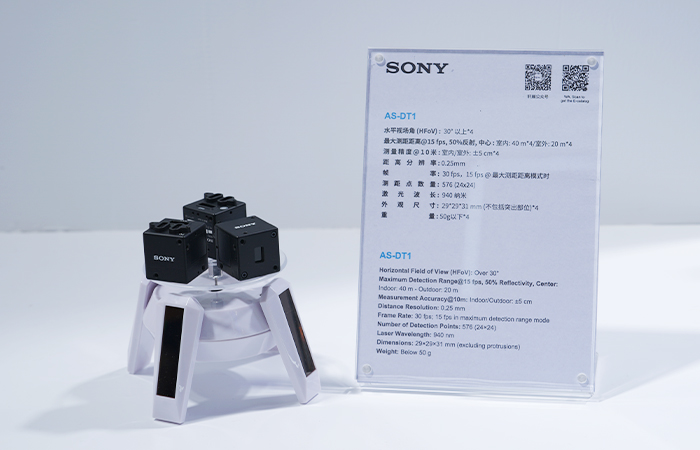
In the same year, the Sony dToF LiDAR Sensor AS-DT1 made another public appearance at the 20th China International Social Public Security Expo, attracting great interest and in-depth discussions among industry professionals.
IV. Industry Applications: From Drones to Smart Factories
The all-weather sensing capability of the Sony dToF LiDAR Sensor AS-DT1 is driving technological leaps across multiple sectors:
1. Drone Sector
Drones integrated with the Sony dToF LiDAR Sensor AS-DT1 have successfully accomplished high-difficulty tasks such as long-distance obstacle avoidance and precision nighttime landing, earning high recognition from the industry.
2. Robot Navigation
In retail stores and warehouses, the Sony dToF LiDAR Sensor AS-DT1 can distinguish between shelf partitions and suspended packages to prevent robotic arm misgrabbing. With AI-assisted point cloud segmentation, it automatically identifies categories including "fixed shelves" and "moving personnel", optimizing AGV path planning.
3. Autonomous Driving
Working in tandem with vehicle-mounted LiDAR systems, the Sony dToF LiDAR Sensor AS-DT1 takes charge of long-range detection (e.g., detecting obstacles of 25 cm height at a distance of 250 meters), while iToF cameras handle short-range detail processing, creating an integrated perception network combining long and short-range coverage.
4. Industrial Inspection
In precision manufacturing fields such as semiconductors and 3C electronics, the Sony dToF LiDAR Sensor AS-DT1 enables micron-level defect detection, helping smart factories improve product yield rates.
Conclusion
From precise obstacle avoidance under scorching midday sun to millimeter-level detection in complete darkness, Sony’s dToF LiDAR sensor redefines the technical boundaries of 3D sensing with its three core advantages: precision, low power consumption, and long-distance performance.
It not only serves as a core perception component for drones, robotics, and autonomous driving, but also empowers developers to explore broader possibilities in AR interaction, intelligent security, and medical imaging through its open technology ecosystem.
The Sony dToF LiDAR Sensor AS-DT1 is scheduled for official launch in spring 2026. This perception revolution driven by single-photon technology is ushering in a new era of all-weather sensing.


