
English
English
Views: 0 Author: Site Editor Publish Time: 2026-08-14 Origin: Site


The Tamron MP3010M‑EV integrated zoom camera module, paired with the MIPI or LVDS to IP Camera Interface Board, delivers industrial‑grade optimization across the full chain: front‑end optical imaging, auto day‑night switching, video signal conversion, encoding & storage, and remote network control. Purpose‑built for unattended, round‑the‑clock continuous monitoring scenarios, this complete solution takes on heavy‑duty non‑stop surveillance tasks.
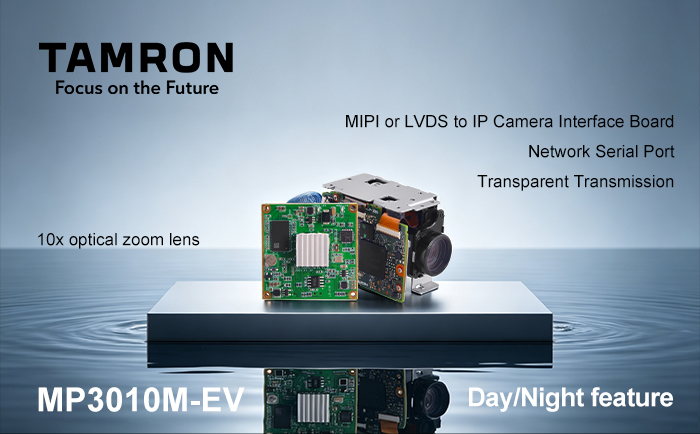
As a compact lightweight 10× zoom camera module, the MP3010M‑EV leverages Sony STARVIS sensor hardware to deliver crisp images under conditions ranging from harsh bright daylight to dim night‑time environments, forming the imaging foundation for round‑the‑clock surveillance.
1. Low‑light Imaging for Clear Day‑and‑Night Performance
Equipped with Sony STARVIS 1/2.8‑inch CMOS sensor, the Tamron MP3010M‑EV achieves a minimum illumination of 0.1 lx in colour mode and 0.025 lx in B&W mode⁽¹⁾. In low‑light settings such as night‑time corridors, field factories and substations, it can still capture complete target outlines, licence plate details and human features.
Built‑in auto ICR infrared cut filter enables seamless colour‑to‑black‑and‑white switching amid light intensity changes, ensuring consistent and stable footage all day long.
A
2. 10× Optical Zoom Balances Overview and Close‑up Details
The Tamron MP3010M‑EV features a 10× optical zoom lens with focal length f=3.3‑33 mm and a large F1.8 aperture for ample light intake. Its 59.2° wide‑angle view covers broad areas, while the 6.7° telephoto angle magnifies distant objects for detail identification. Combined with 16× digital zoom, distant targets on utility poles, perimeter fences and river banks can be clearly recognised.
3. Wide Dynamic Range & Multi‑level Noise Reduction for Reliable Output in Extreme Lighting
Integrated with WDR wide dynamic range, strong light suppression and digital de‑haze functions, the Tamron MP3010M‑EV handles backlit gateways, direct vehicle headlight glare, rainy and foggy conditions. It balances bright and dark zones to avoid overexposure in bright areas and total blackness in shadowed regions. With an ultra‑high 50 dB signal‑to‑noise ratio, noise is well controlled during long‑duration recording, preserving complete details for playback and forensic review.
4. Lightweight & Low‑power Design for Long‑term Operation in Enclosed Equipment
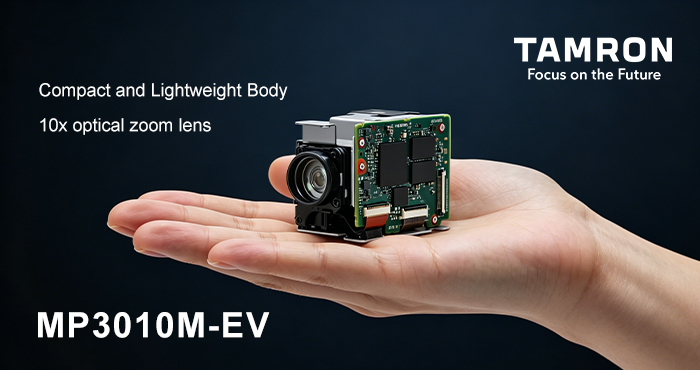
Weighing only 70 g with an overall length of 59 mm, the compact MP3010M‑EV is easy to integrate into speed domes, PTZ cameras and airborne payloads. It consumes merely 2.5 W at static status and peaks at 4.4 W during dynamic operation. Stable surveillance performance can be maintained even when powered by solar energy systems.
High‑performance zoom camera modules alone cannot support round‑the‑clock surveillance. Signal conversion, encoding, storage, remote control and long‑term reliability rely on collaboration with the MIPI or LVDS to IP Camera Interface Board.
This board encodes 1080P@60fps video into H.265 / H.264 streams and outputs standard RTSP / ONVIF / GB/T28181 signals via RJ45 Ethernet port.
| Capability | Description |
|---|---|
| Supports ONVIF and GB/T28181 national standard protocols | Directly connect to security platforms, smart parks and power operation & maintenance systems |
| Long‑distance transmission | Overcome short‑cable limitations; video streams transmitted over RJ45 Ethernet to NVR or remote platforms |
| Network serial port transparent transmission | Remote camera control via Web UI with VISCA commands for zoom, focus, exposure and other adjustments |
| Dual‑stream & SD card support | Local high‑definition recording plus low‑bandwidth transmission with H.265/H.264 low‑bitrate streams; Micro SD card for local backup storage |
| Compact size & low power consumption | Approx. 42.5 × 42.5 × 16 mm; easy integration for speed domes, PTZ units and miniature devices |
Scenario 1: Unattended Monitoring for Power / PV / Base Station Sites
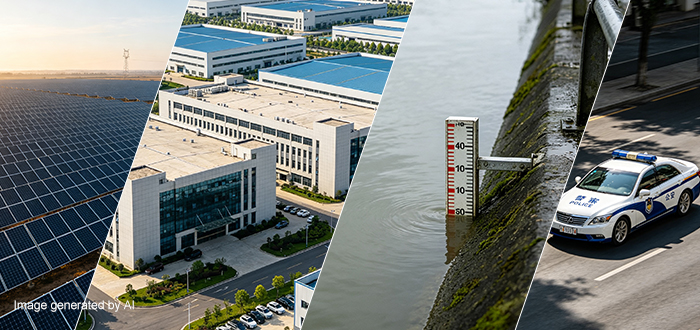
24‑hour security inspection for substations, outdoor utility poles, photovoltaic farms and communication base stations. It captures equipment conditions and intruding personnel under night‑time low‑light conditions. Long‑range network transmission enables real‑time remote monitoring at operation centres with automatic alarms for anomalies, reducing manual night patrol workload.
Scenario 2: Full‑range Security for Construction Sites / Parks / Industrial Premises
Round‑the‑clock monitoring along factory perimeters, construction site entrances and storage yards. Persons and vehicles can be clearly identified day and night. Scheduled auto‑cruise and cyclic recording retain complete video evidence for incident investigation.
Scenario 3: River Basin Monitoring, Forest Fire Prevention & Field Ecological Observation
For remote dispersed field locations without mains power supply, solar power supply and 4G wireless transmission are supported. Zoom capability enables long‑range observation of fire hazards and river water levels, delivering non‑stop night‑time monitoring with no on‑site manpower required.
Scenario 4: All‑weather Forensics for On‑board & Mobile Emergency Deployment
Installed on law‑enforcement vehicles and emergency command vehicles for continuous day‑and‑night recording. EIS electronic image stabilisation together with stable encoding delivers smooth footage under vehicle vibration, meeting requirements for all‑weather mobile forensic recording.
The Tamron MP3010M‑EV delivers solid imaging performance day and night, while the MIPI or LVDS to IP Camera Interface Board acts as the stable hub for signal conversion, encoding, storage and remote maintenance. Deep hardware‑software synergy achieves true 24/7 non‑stop surveillance.
Reference
[1]
MP3010M‑EV
https://www.tamron.com.cn/cctvlens/products/MP3010M‑EV.shtml
FAQ
Q: Are there any smaller zoom camera modules than Tamron MP3010M‑EV?
A: Sensor and lens dimensions correlate with imaging quality. To preserve image performance, the physical size of the module is determined by sensor and lens specifications.
Q: Can the MIPI or LVDS to IP Camera Interface Board convert video signals from both MIPI and LVDS camera modules into IP‑based video simultaneously?
A: No. Only one input type is supported at a time: either a MIPI camera module or an LVDS camera module, simultaneous connection is not available.


