
English
English
Views: 0 Author: Site Editor Publish Time: 2026-10-16 Origin: Site


In a neurosurgical intraoperative monitoring system, the surgical field camera system is responsible for presenting and preserving the images seen under the microscope and within the surgical area—without glare, with low latency, and with full traceability throughout the procedure. It serves to extend the surgeon's field of view, support teaching, enable remote consultation, and provide quality control archiving.
How the Sony FCB-EV9520L + HD-HDMI Compatible Interface Board Solution Works:
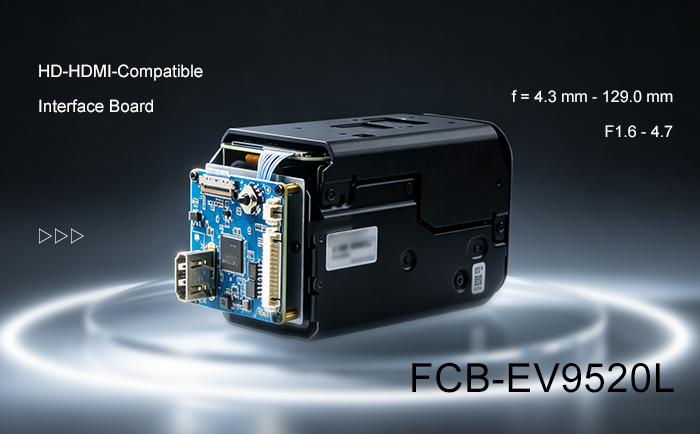
1. Sony FCB-EV9520L is responsible for video acquisition, solving challenges such as glare in the surgical field, imaging in different complex environments, color reproduction, and stable focusing.
2. HD-HDMI Compatible Interface Board is responsible for video signal conversion and zoom camera module control. It converts the LVDS video signal from the Sony FCB-EV9520L into HDMI and provides VISCA / RS-485 control for the camera.
This is the most easily confused point before selection, and also the starting point where many solutions are questioned by hospitals.
Its value lies in synchronizing the images the lead surgeon sees under the microscope to the second surgeon, the teaching room, remote experts, and the medical record system. Synchronization and archiving of surgical field images are indispensable.
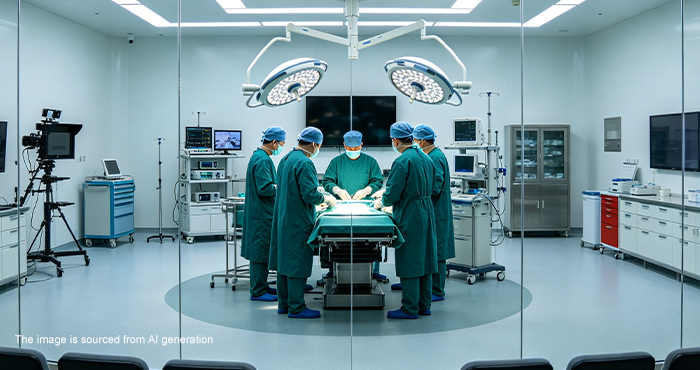
Ordinary cameras cannot enter the operating room, not because their resolution is insufficient, but because they cannot pass these five tests:
1. No failure under intense shadowless lamp illumination
Surgical shadowless lamps provide extremely high illuminance, and the brightness difference between the surgical field and surrounding tissue is enormous. Ordinary equipment becomes directly overexposed into a sheet of white. What is needed is true color reproduction under high brightness, automatic strong-light suppression, and wide dynamic range.
2. Visibility in deep, narrow cavities
Neurosurgical fields are deep and the channels are narrow, with an extremely large span from a panoramic view of the skin flap to deep blood vessels and nerves. This requires high-magnification optical zoom + close-up focusing.
3. No loss of focus when instruments enter and exit
Suction devices and electrocautery forceps frequently enter and exit, and the main subject of the image repeatedly switches. This requires fast, stable autofocus and image stabilization.
4. Low image latency
In remote consultation and live surgery scenarios, latency directly affects the value of guidance. A low-latency transmission method is required.
5. Full-process archiving and traceability
Quality control spot checks, teaching reviews, and dispute evidence all require complete recording with timestamps. Stable HDMI output is needed to connect to recording/storage systems.
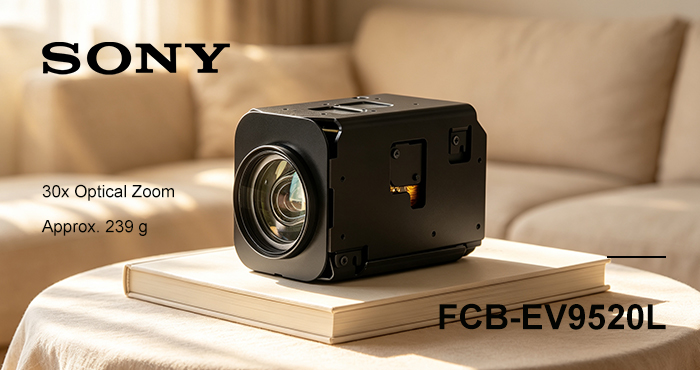
The FCB-EV9520L is an HD autofocus camera module launched by Sony. It is equipped with a 1/2.8-inch Exmor CMOS sensor, has approximately 2.38 million effective pixels, and supports 1920×1080 Full HD resolution output. For neurosurgery, this resolution is sufficient to clearly present key details such as the course of blood vessels and the distribution of nerve bundles in the surgical area.
Our company, an official authorized dealer of Sony (China), points out that its low-light performance is even more noteworthy. During surgery, doctors sometimes need to dim ambient light to observe fluorescence imaging or other special images. At this time, the camera module's imaging capability in low light becomes particularly important. Through the combination of sensor technology and signal processing algorithms, the FCB-EV9520L can still maintain usable brightness and detail levels in low-light environments, avoiding the loss of key information due to insufficient fill light.
In addition, the Sony FCB-EV9520L supports 30x optical zoom. During surgery, it can zoom in to observe the fine structures of the lesion area without moving the camera position. Autofocus, auto white balance, and other functions reduce the frequency of manual image intervention during surgery. [1]
The raw video signal captured by the front-end zoom camera module needs to undergo encoding processing before it can be transmitted to monitors, recording devices, or remote teaching terminals. The HD-HDMI Compatible Interface Board is responsible for signal conversion, compression encoding, and output control in this stage.
Another key role of the HD-HDMI Compatible Interface Board is to reduce transmission latency, adapt to intraoperative real-time monitoring needs, ensure synchronized images with no lag, and align with the pace of surgical operations.
The requirements of neurosurgical intraoperative monitoring for imaging systems are not about the extremes of any single parameter, but about the stability and reliability of the overall link. The Sony FCB-EV9520L camera module provides HD, low-light, and high-zoom imaging capabilities at the front end, while the HD-HDMI Compatible Interface Board ensures timely signal output and control at the back end. Together, they provide a smoothly connected reference solution for intraoperative image acquisition and transmission.
Q: The native output of the FCB-EV9520L is LVDS. Can it be used directly without an encoding board?
A: No. The video output of the FCB-EV9520L is LVDS, which is a high-speed differential interface inside the camera module. It cannot be directly connected to HDMI/SDI monitors, recording hosts, or consultation terminals. Interface conversion must be completed through an Interface board.
[1] FCB-EV9520L
https://pro.sony/ue_US/products/zoom-camera-blocks/fcb-ev9520lDanny Wang, Co-founder and CTO of Our company, compiled in September 2026.
Our company, an official authorized Distributor of Sony (China), with 17 years of experience in HD video secondary development. It has successively developed IP / SDI / HDMI-Compatible / USB / MIPI and DSLR cameras network interface boards(suitable for ILX-LR1), providing pre-sales, during-sales, and after-sales technical consultation and support, as well as technical coordination with Sony's original factory and on-site problem resolution.


