
English
English
Views: 0 Author: Site Editor Publish Time: 2026-07-14 Origin: Site


The zoom system constitutes the core optical structure of an integrated camera block. Two mainstream designs are available on the market: external zoom (telescopic barrel zoom) and internal zoom (fixed-barrel built-in zoom). Their fundamental distinctions lie in mechanical movement during zooming, optical stability and engineering adaptability, which also serve as the key dividing line between consumer-grade camera blocks and industrial professional-grade camera blocks.

| Comparison Dimension | Internal / Power Zoom | External / Trombone Zoom |
|---|---|---|
| Zoom Camera | Lens groups move entirely inside the barrel; overall barrel length remains constant | Front lens group or barrel section extends and retracts forward/backward; barrel length changes with focal length |
| Center of Gravity Shift | Center of gravity stays nearly unchanged throughout zooming, benefiting gimbal load balance and image stabilization | Center of gravity shifts forward at telephoto ranges, disrupting balance for UAV pods and pan-tilt units |
| Optical Axis Consistency | Precision internal guide rails minimize optical axis drift during zoom, delivering consistent focus and exposure | Mechanical extension and retraction introduce minor wobble, causing subtle optical axis deviation at long focal lengths |
| Structural Cost | Requires precision cams, guide rails and stepper motors; complex construction with slightly higher cost | Simple mechanical design at low cost, widely used in entry-level or high-zoom portable cameras |
| Typical Applications | High-end broadcast lenses, Sony FCB series | Consumer digital cameras, certain high-magnification travel zoom lenses |
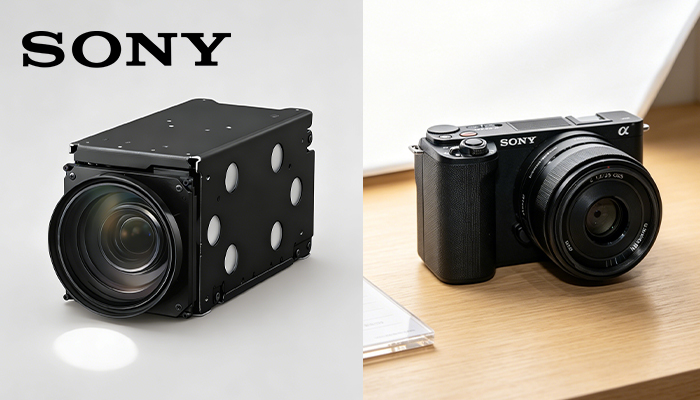
The Sony FCB-ER9500 is Sony’s new-generation 4K/60p integrated camera module, equipped with a 1/1.8-inch STARVIS 2 CMOS sensor and 25× optical zoom. Its internal zoom architecture delivers exceptional integration convenience for system integrators:
1. Fixed Form Factor – Zero Structural Interference for Compact Devices
The barrel dimension of the Sony FCB-ER9500 remains constant at 56.0×64.0×125 mm. When embedded into UAV pods, medical surgical arms or industrial inspection probes, zoom operation will not collide with enclosures or alter internal space occupancy of equipment, eliminating the need to reserve extra travel clearance required by external zoom lenses.
2. Stable Center of Gravity – Enhanced Gimbal & Robotic Arm Stability
The Sony FCB-ER9500 maintains a fixed center of gravity across the full zoom range. UAV 3-axis gimbals require no rebalancing, and medical robotic arms avoid extra torque disturbance triggered by zoom adjustments.
3. Superior Optical Axis Consistency – No Target Loss at Telephoto Distances
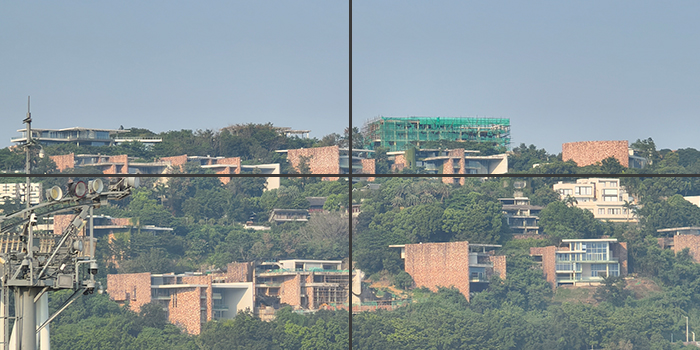
Precision internal guide rails of the Sony FCB-ER9500 restrict optical axis offset to an extremely low level. Focus and exposure remain consistent from wide-angle all the way to 25× telephoto, avoiding the peripheral aberration fluctuations and focus drift common to external zoom systems. This guarantees clear visibility of tiny distant defects such as power line corrosion and PCB silkscreen markings.
4. VISCA Motorized Zoom – Smooth, Controllable & Remote-Ready
Built-in stepper motors drive the internal zoom groups, supporting zoom speed adjustment and direct position targeting via the VISCA protocol (TTL/CMOS 3.3V level). Zoom transitions run uniformly and smoothly without jerky "accordion" motion, ideal for video recording and remote linkage with PTZ pan-tilt systems.
Conclusion
Compared with the telescopic structure of external zoom lenses, the internal zoom system of the Sony FCB-ER9500 eliminates integration risks at the mechanical level through fixed dimensions, constant center of gravity, superior sealing performance and excellent optical axis consistency. This represents the core competitive edge that differentiates premium industrial camera modules from standard external zoom solutions, and lays the foundation for steady zoom operation and high-definition imaging for UAV, medical and industrial equipment applications.


